Project Scope
The Wisconsin Racing Formula SAE team had relied on a legacy gearbox design for several years, despite ongoing performance, reliability, and serviceability issues. At the same time, the transition from a 300V to 600V electric powertrain required a fundamental redesign of how power was transmitted to the wheels.
Additional challenges included loss of institutional knowledge following COVID-related disruptions and high manufacturing costs limiting iteration on previous designs.
To address these issues, I led a full redesign of the gearbox system with a two-year development cycle focused on improving durability, reducing mass, enabling proper sealing, and establishing a data-driven engineering framework for future teams.
System Architecture & Optimization
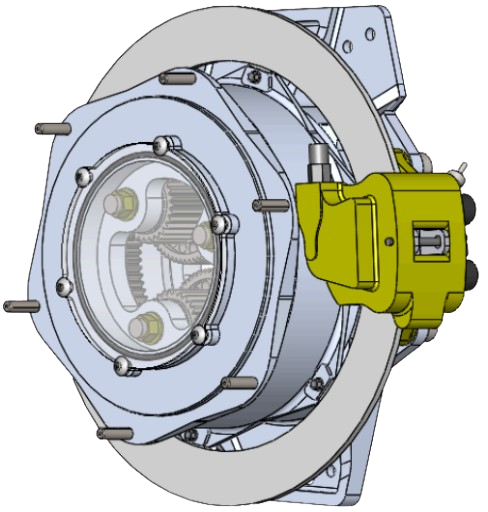
Redesigned the gearbox architecture to address key failure modes and improve system robustness.
Key improvements included:
- Elminating internal fasteners to prevent critical retention failures
- Decoupling bearing preload from wheel lug torque
- Introducing dynamic sealing to enable oil lubrication
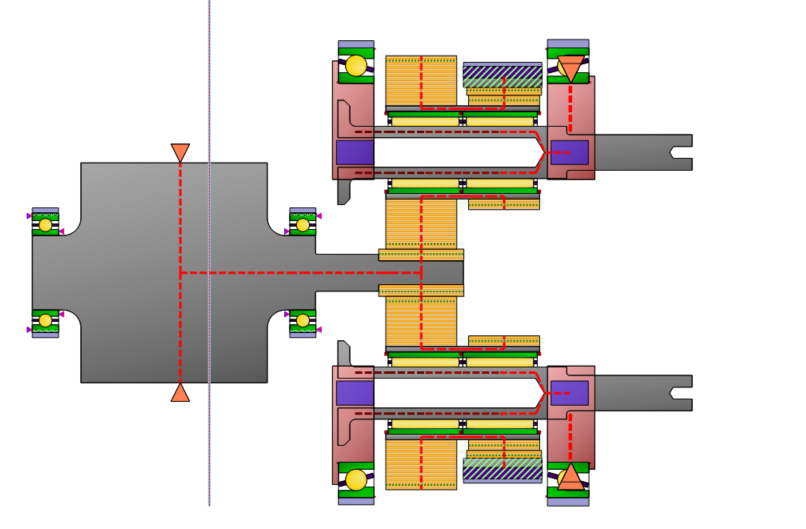
Conducted full system load analysis to optimize gear design, bearing selection, and housing structure. Developed a bearing life calculator to guide selection, resulting in significant weight reduction while maintaining durability targets.
These changes enabled a 20% reduction in total system mass while improving reliability and serviceability.
Cross Functional Considerations
The gearbox was fully integrated within the suspension upright and interfaced directly with the braking system, requiring close coordination with chassis and suspension teams.
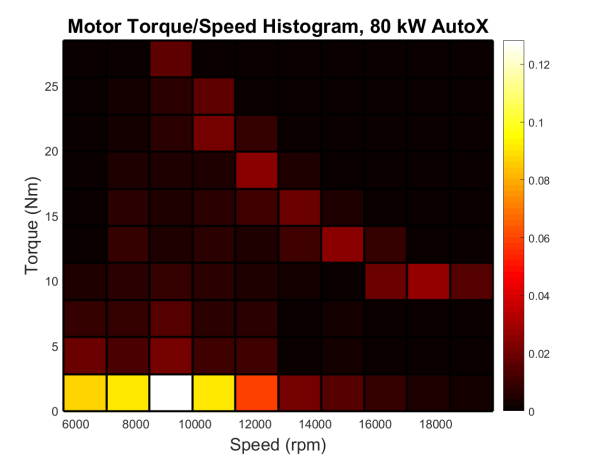
Collaborated with vehicle dynamics and lap time simulation teams to define optimal gear ratios based on acceleration performance, duty cycle, and efficiency targets.
Gear Design
Defined a target gear ratio of ~11.8:1 based on vehicle performance requirements and simulation data.
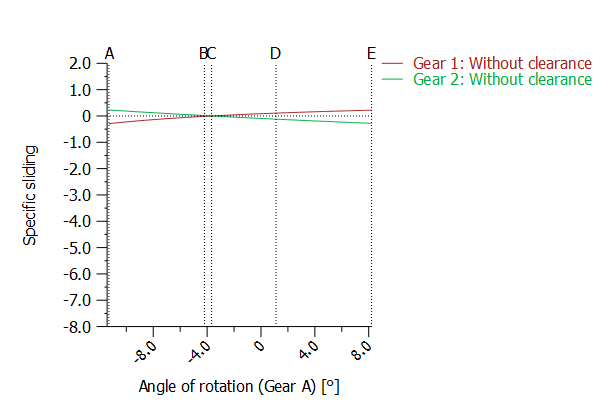
Using ISO 6336 standards and KISSsoft, I generated and evaluated 1000+ gear geometries to converge on an optimized solution.
The selection process balanced:
- Flank and root fatigue life
- Packaging constraints (outer diameter limits)
- Specific sliding and efficiency
- Hunting ratio and wear distribution
- Tooth profile shift and manufacturability
The final design achieved an output ratio of 11.76:1 while meeting all durability and packaging constraints.
Housing & Packaging Design
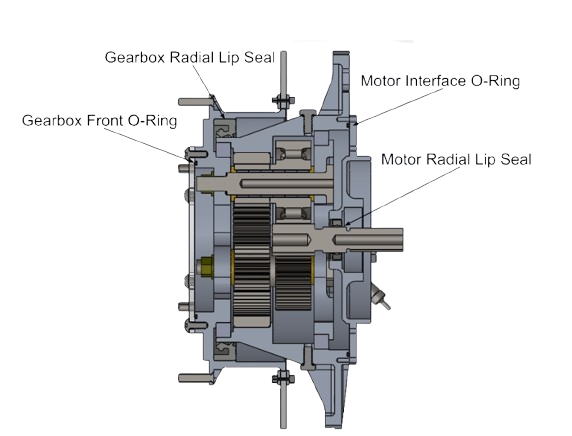
Designed a compact gearbox housing integrated within the wheel assembly, balancing structural rigidity, alignment precision, and minimal unsprung mass.
The design incorporated:
- Direct wheel coupling
- Suspension mounting integration
- Integrated sealing for oil lubrication
- Interfaces with braking components
- Bearing pre-load independent of wheel lug torque
- Improved sealing architecture to allow for oil lubrication
The improved housing design allowed for an imoprovement in efficiency, reduced wear, and eliminated the need for frequent teardown and maintenance due to the consistency improvement of the bearing pre-load as well as the dynamic seals allowing for oil lubrication.
Multi-Level Analysis
A multi-level validation approach was used to ensure system performance and durability:
Component-Level Analysis:
- Planet pin sizing using beam bending calculations
- Bearing selection using loads from lap time simulation
- Strength validation using ANSYS
System-Level Analysis:
- Developed full geartrain model in MASTA
- Evaluated system deflection and its impact on gear meshing
- Analyzed load distribution and alignment sensitivity
This approach ensured durability targets were achieved without overdesigning the system.
Summary
The redesigned gearbox architecture was implemented in the Wisconsin Racing 225e vehicle, delivering improved reliability, reduced mass, and enhanced system performance compared to the legacy design.
The project established a scalable, data-driven engineering framework, integrating simulation-based design, standards-driven validation, and system-level modeling that future teams can build upon.
This work demonstrates full-system ownership of a high-performance drivetrain, from architecture definition through detailed analysis and implementation.